Key takeaways
- A vCISO platform lets a virtual CISO, MSP or MSSP run security and compliance programs for many clients from one place.
- The real test is not the feature list. It is whether the platform can show a CEO and board, with evidence, how secure the organization is and what is being done about it.
- Look for a picture built from each client's own security tools, risks that end in decisions, and reporting a board can read without translation.
- Compliance should come out of running the program well, not be the whole program.
What is a vCISO platform?
A vCISO platform is software that helps a virtual or fractional CISO, MSP or MSSP manage cybersecurity and compliance programs for multiple clients from a central workspace. It standardizes assessments, tracks risks, manages policies and vendors, and produces executive reports across frameworks like SOC 2, ISO 27001, NIST CSF, CMMC and HIPAA.
That definition is accurate, and it is also where most comparisons stop. It describes what the software stores. It does not describe what the person using it is trying to achieve.
The question every CISO has to answer
Sooner or later, every CISO sits in front of a CEO or a board and gets asked some version of the same question: are we secure, and how do you know?
Jeff Sowell, who built Radius360, puts the origin plainly: "As a CISO, I needed a 360 view of our security posture so I could provide assurances to the CEO and board."
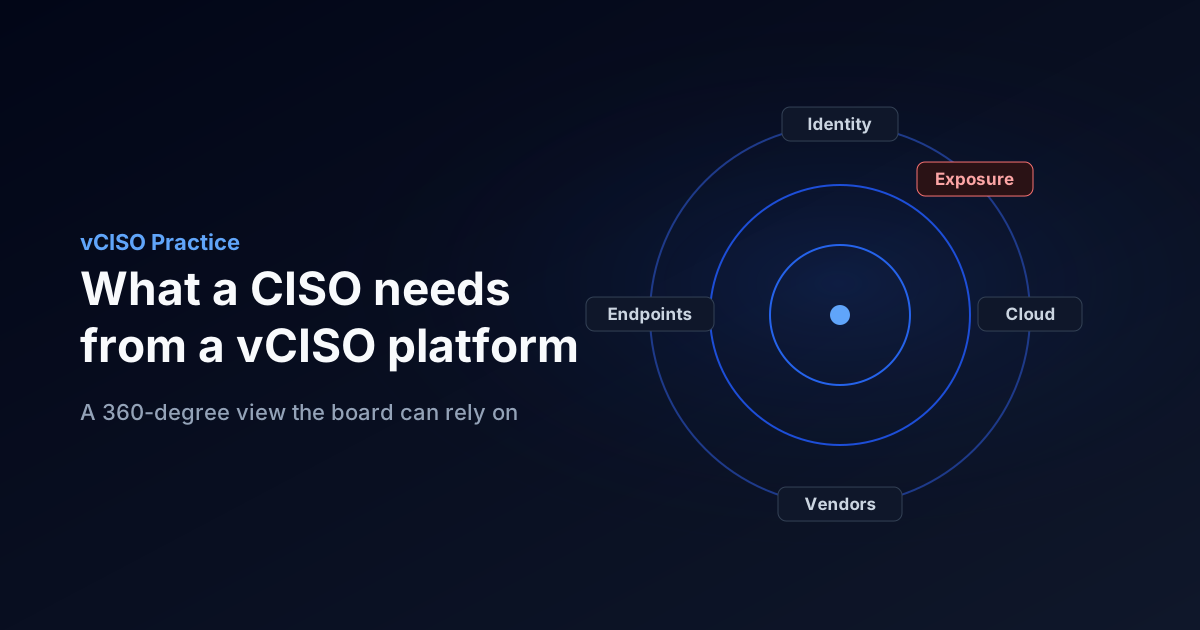
Questionnaires and spreadsheets can tell you what is supposed to be in place. They cannot show what is actually happening across identity, cloud, endpoints and vendors this week, or which gap matters most. A vCISO doing this for ten clients has the same problem ten times over. That is the job a vCISO platform has to do.
Seven things to look for
1. A workspace per client, and one view across all of them
Each client needs its own risks, frameworks, policies, evidence and branding, kept separate. The practice needs one view across every client: who is improving, who is slipping, and what needs attention first. If the platform makes you open a separate account per client, it will cap how many clients you can serve well.
2. A picture built from live data, not only from questionnaires
Assessments matter, but answers to a questionnaire describe intent. Ask how the platform learns what is really true in a client's environment. The strongest platforms connect to the client's identity provider, cloud accounts, endpoint and vulnerability tools, and turn what those tools find into scored risks mapped to controls.
3. Exposure you can see
Boards ask what is exposed and what it could reach. Look for topology and attack surface views: which systems face the internet, which sensitive data they connect to, and which of them carry a known-exploited vulnerability. A diagram drawn from real integration data, dated and reviewable, is also evidence many frameworks expect.
4. Risks that end in decisions
A list of 400 tasks is not a security program. A good platform consolidates findings into a manageable set of risks, proposes what to do about each one, and records who decided, when and why. That decision record is what makes your assurance defensible later.
5. Compliance as a by-product
Clients need SOC 2, ISO 27001, HIPAA or CMMC, and often more than one. Look for cross-framework mapping, so a single piece of evidence counts everywhere it applies, and for evidence that is collected from connected tools rather than screenshots gathered the week before an audit.
6. Reporting a board can read
The output that matters most is the one the CEO reads. Look for board and per-client reports generated from live data, in business terms, with trends, top risks and decisions needed, and with your firm's branding. If you still copy numbers into slides every quarter, the platform is not doing its job.
7. Honesty about coverage
No platform sees everything. Good ones say what they can and cannot see: which integrations contributed, when each last synced, and which relevant sources are missing. Be wary of any score that never mentions what it does not know.
Platform, assessment tool or compliance automation?
| Type | Built for | Where it falls short for a vCISO |
|---|---|---|
| Assessment tool | Point-in-time questionnaires and gap reports | Little ongoing data, so the picture goes stale between assessments |
| Compliance automation | One company getting through an audit | Strong on evidence, light on risk decisions and multi-client delivery |
| vCISO platform | Running whole security programs for many clients | Varies widely: check the seven points above |
Questions to ask in a demo
- Show me how one client's risks were created. Which came from a questionnaire and which from a connected tool?
- What can I see about this client's internet exposure today?
- When a risk is accepted, where is the record of who decided and why?
- Generate a board report for this client now. What would I still have to edit?
- Which of this client's systems can you not see, and how would I know?
- How does pricing change between my fifth client and my fiftieth?
Where Radius360 fits
Radius360 was built around those questions: a workspace per client, risks created from 23 deep integrations with tools such as Microsoft 365, Okta, CrowdStrike, Sekoia and Tenable, topology and attack surface diagrams, agents that propose the next move for a person to approve, and board reports from live data. You can compare it directly with Cynomi, RealCISO, Vanta and Drata, or see the vCISO platform overview.